
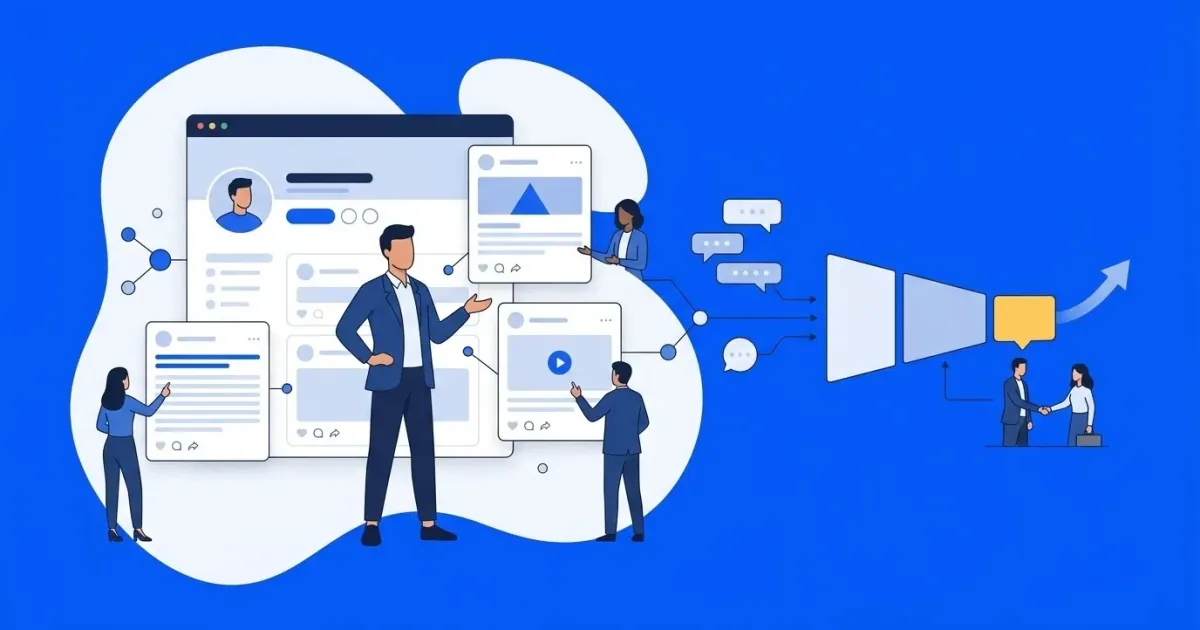
Here is a pattern almost every B2B SaaS company has noticed but few act on: the founder's personal LinkedIn posts reach ten times more people than the company page, with a fraction of the effort.
This is not an accident. LinkedIn's feed is built around people, not logos. Buyers follow humans they trust, and the algorithm rewards personal accounts with reach that company pages simply cannot match.
Founder-led LinkedIn is the playbook for turning that reality into pipeline: positioning your founder or senior leaders as the voice of the company, publishing consistently in their name, and converting the attention into qualified conversations.
This guide covers how to set it up, what to post, how to ghostwrite without losing the founder's voice, and how to measure it properly.
1. Why Personal Profiles Beat Company Pages
Run this test on your own account: compare the average reach of your last five company-page posts with the founder's last five personal posts. In almost every case, the personal posts win by a wide margin.
Three reasons explain the gap:
- The algorithm favours people. LinkedIn wants users to spend time in the feed, and content from real people keeps them there. Company posts get throttled unless they are backed by advertising spend.
- Trust attaches to faces. A named person with a track record is credible. A logo is an advert. Buyers know the difference instantly.
- Comments compound. When a founder replies to comments personally, each reply pushes the post back into the feed. Company pages rarely earn that kind of conversation.
For B2B SaaS in Southeast Asia this matters even more. Deals in Singapore, Malaysia, the Philippines and Indonesia are relationship-driven, and LinkedIn is where those relationships now start.
2. Position the Founder Around Three Content Pillars
The biggest mistake in founder-led content is posting about everything. Reach without focus builds an audience that will never buy.
Instead, choose three content pillars tied directly to the pains of your ideal customer profile. A useful structure:
- Pillar 1: The problem you solve. Opinions, observations and teardown posts about the pain your product addresses. This attracts exactly the buyers who feel that pain.
- Pillar 2: The journey. Lessons from building the company: wins, mistakes, numbers where you can share them. This builds trust and makes the founder followable.
- Pillar 3: The industry. Takes on where your market is heading. This positions the founder as someone worth listening to, and someone AI engines and journalists start to quote.
Write the three pillars down. Every post should fit one of them. If it does not, it may entertain, but it will not build pipeline.
3. The Weekly Cadence: Story, POV, Proof
Consistency beats brilliance on LinkedIn. Three posts a week, every week, will outperform ten posts one week and silence the next. A simple rotation keeps quality high without burning the founder out:
Monday: the story post
A short personal story with a business lesson. A client situation, a mistake, a decision that went sideways. Stories earn the most reach because they are the most human.
Wednesday: the POV post
A clear opinion about your industry or the problem you solve. Take a side. Posts that politely agree with everyone reach no one.
Friday: the proof post
Evidence that your approach works: a client result, a milestone, a before-and-after, a lesson from a real project. This is the post that quietly converts followers into enquiries.
4. Ghostwriting Without Losing the Founder's Voice
Most founders do not have time to write three posts a week. Ghostwriting solves this, but done badly it produces generic content that sounds like everyone else's feed. The fix is a workflow built on the founder's actual words:
- Step 1: Interview. A 30-minute voice call or voice notes once a fortnight. The writer asks about recent client conversations, decisions, frustrations and wins. This raw material is the founder's voice.
- Step 2: Draft. The writer turns the interview into six to eight posts, keeping the founder's phrases, rhythm and opinions. Nothing is invented. If the founder did not say it or believe it, it does not go in.
- Step 3: Approve. The founder reviews drafts in one sitting, edits anything that feels off, and approves the batch. Approval should take fifteen minutes, not a rewriting session. If it takes longer, the interview stage needs work.
Total founder time: about 45 minutes a fortnight for a consistent, authentic presence. That is the trade that makes founder-led content sustainable.
5. Converting Engagement into Pipeline
Reach is only the start. The pipeline is built in the conversations that follow. Three habits do the converting:
Reply to every comment
Each reply extends the post's reach and starts a visible relationship. Commenters this week become connections next week and enquiries next quarter.
Comment outward daily
Ten minutes a day commenting thoughtfully on posts from ideal customers and industry voices puts the founder in front of exactly the right audience, without posting anything.
Move warm conversations to DMs, gently
When someone engages repeatedly, a short, no-pitch message works: "Thanks for the thoughtful comments lately, curious what prompted your interest in this topic?" No links, no calendar booking, no pitch. Just a conversation between two professionals. The pipeline follows.
6. Measure Pipeline, Not Impressions
Impressions and follower counts are comfortable metrics because they always go up. They are not the goal. Track what connects to revenue:
- Profile actions. Profile views and connection requests from people matching your ICP.
- Inbound conversations. DMs and enquiries that reference the founder's content. Ask every new lead "how did you hear about us" and log the answer.
- LinkedIn-influenced pipeline. Deals where the buyer engaged with the founder's content before or during the sales cycle. Your CRM source fields and self-reported attribution capture this.
Expect a lag. Founder-led content typically takes three to six months before pipeline effects show clearly. The buyers reading silently today are the enquiries of next quarter.
Getting Started This Month
You do not need a big production to begin. Define the three pillars, book the first founder interview, and commit to three posts a week for ninety days. Consistency and genuine opinions will do the rest.
If you would rather have the interviews, writing and engagement handled for you, that is exactly what our social media management service does: founder-led LinkedIn programmes built for B2B pipeline, not vanity metrics.