
Stop Waiting for Inbound: The SaaS Outbound Lead Generation Playbook
Most early-stage SaaS brands place their entire bet on inbound. They publish blog posts, share content on LinkedIn, run some ads, and then wait for leads to come in.
Waiting, however, is not a pipeline strategy.
Inbound marketing is valuable. But it takes six to twelve months to produce consistent, qualified results. If you are building a SaaS business and you need pipeline this quarter, inbound alone will not get you there fast enough.
Outbound lead generation solves that problem. Done correctly, it can get qualified meetings on your calendar within weeks, not months.
The challenge is that most people still picture outbound as cold calling from a list of random phone numbers or sending the same email blast to five thousand strangers. That version of outbound is dead. What works today is targeted, personalised, and built on the right systems.
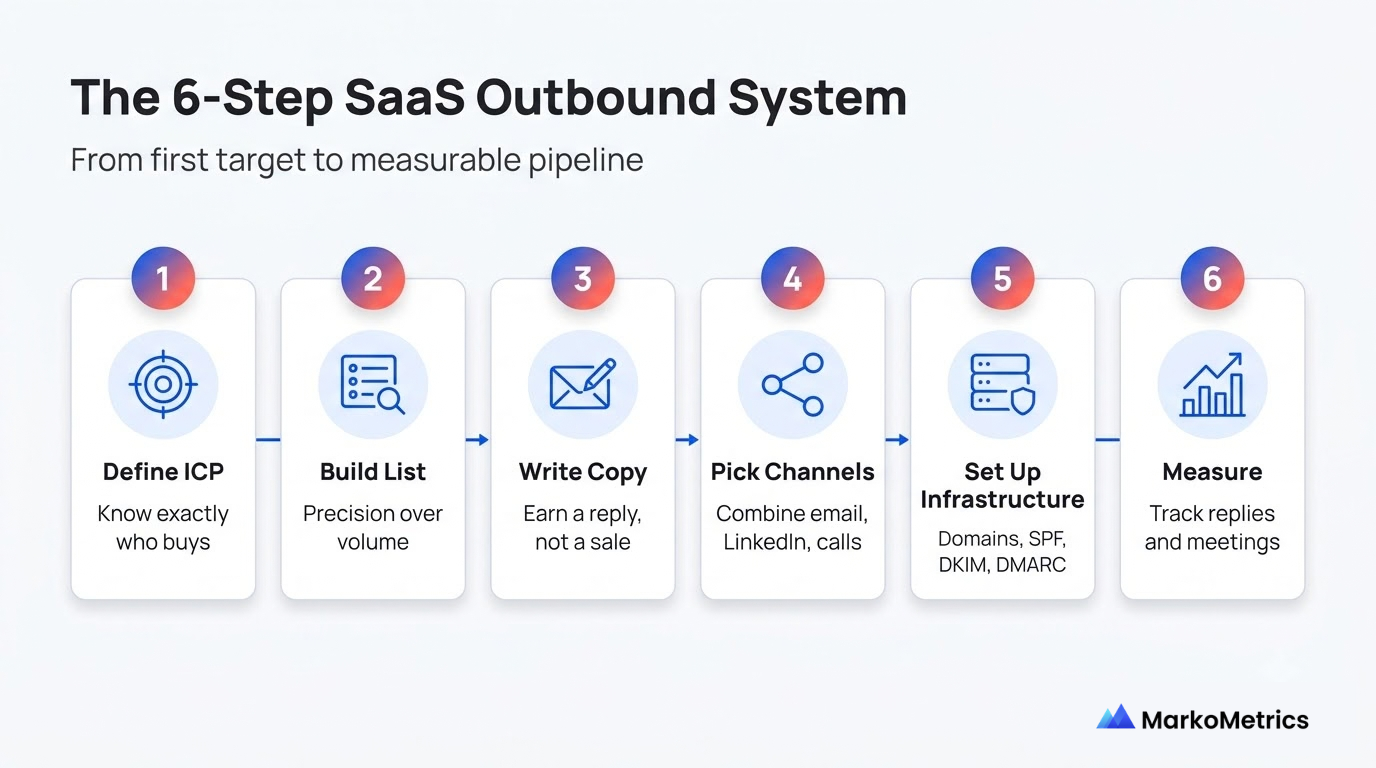
This playbook walks you through exactly how to build an outbound lead generation system for your SaaS brand in 2026, from defining your ideal customer to measuring results that actually matter.
Why Outbound Still Works for SaaS
Before diving into the how, it is worth addressing the most common objection: "Is outbound even worth it anymore?"
The honest answer is yes, when it is done with intention.
Spray-and-pray outbound is dead. Buying a list of ten thousand emails and blasting the same generic pitch to all of them produces nothing except a damaged sender reputation. But strategic, well-researched outbound continues to drive significant revenue for SaaS companies at every stage.
Here is why outbound works particularly well for SaaS brands:
You control who you reach. Unlike inbound, where you wait for the algorithm to bring people to you, outbound lets you choose exactly which companies and decision-makers to contact. You are not dependent on search rankings or ad spend to get in front of your ICP.
Feedback is fast. Within two to three weeks of running an outbound sequence, you will know if your targeting is off, if your message is landing, or if your offer needs adjustment. Inbound takes months to give you that same level of feedback.
It runs in parallel with inbound. Outbound and inbound are not competing strategies. Outbound fills your pipeline now while inbound builds momentum for later. The strongest SaaS go-to-market strategies use both at the same time.
Think of it this way: outbound gives you demand today. Inbound gives you demand in six months. You need both.
Step 1: Define Your ICP Before You Send a Single Email
This is where most outbound campaigns fail before they even begin.
An Ideal Customer Profile (ICP) is a detailed description of the specific type of company that is most likely to buy your product, get genuine value from it, and stay a paying customer over time. Without a clear ICP, you are guessing who to reach, and guessing is expensive.
For SaaS brands, a complete ICP typically includes the following dimensions:
| ICP Dimension | Example |
|---|---|
| Industry | HR tech, FinTech, EdTech, Legal SaaS |
| Company size | 50 to 500 employees |
| Geography | US, UK, India, or Southeast Asia |
| Tech stack | Uses HubSpot, Slack, Salesforce, AWS |
| Buyer job title | VP of Marketing, Head of Sales, Founder |
| Trigger events | Recent funding round, new leadership hire, product launch |
The most reliable way to define your ICP is to look at your best existing customers. Who are they? What industry are they in? What problem were they trying to solve when they found you? What do they have in common?
If you are pre-revenue or early stage, look at the customers you most want to serve, and validate that profile through research and conversations before you invest in a full outbound campaign.
One important rule: never skip this step to move faster. Reaching the wrong people with a perfect message still produces zero results. Precision over volume, always.
Step 2: Build a Targeted Prospect List
Once your ICP is clear, the next step is building a list of real companies and contacts that match it.
This is not about finding as many names as possible. A focused list of five hundred highly relevant prospects will consistently outperform a bloated list of five thousand loosely matched contacts.
Here are the tools that work best for SaaS prospect list building:
Apollo.io is one of the most versatile tools available. You can filter by industry, company size, job title, geography, and even the technology a company uses. It gives you verified email addresses and direct dials.
LinkedIn Sales Navigator is the best option for reaching senior buyers at the VP and C-suite level. The advanced filters let you get very specific about who you want to target, and it is particularly effective for enterprise outreach.
Clay is a more advanced tool that lets you build dynamic, enriched lists by pulling data from multiple sources and running automated research at scale. It is ideal once you have found a repeatable outbound motion and want to speed it up.
Crunchbase is excellent for identifying companies that have recently raised funding, which is one of the strongest trigger events for SaaS outreach. A company that just closed a Series A is actively investing in tools to support growth.
A few non-negotiable rules for list building:
Never buy generic email lists from third-party vendors. They are almost always outdated, poorly targeted, and will cause serious damage to your email deliverability.
Always verify emails before sending. Tools like NeverBounce or Zerobounce reduce bounce rates, which protects your sender reputation.
Segment your list before you use it. Group contacts by industry, company size, or trigger event so your messaging can be specific to each group rather than generic across all of them.
Step 3: Write Outbound Copy That Gets Replies
This is the part most teams get wrong, and it is the most important part of your outbound system.
The biggest mistake in outbound copywriting is leading with your product. Nobody wants to read an email from a stranger that immediately talks about features, pricing, and how great a company is. That email gets deleted in two seconds.
The goal of your first outbound email is not to sell. It is to earn a reply.
Here is a simple four-part structure that works reliably for SaaS outbound:
Part 1: The Personalised Hook
Open with something specific to them. Not "I came across your company and was impressed." That is generic and unconvincing. Instead, reference something real. A blog post they published recently, a job listing that signals a pain point, a product update they announced, or a piece of news about their company.
A good hook shows the prospect that you have actually paid attention to them. That alone separates you from ninety percent of the cold emails they receive.
Part 2: The Relevant Problem
Name a specific challenge that companies like theirs typically face. Be precise. If you serve HR SaaS companies, do not write "we help businesses grow faster." Write something like "most HR platforms at your stage struggle to convert trial signups into long-term paid accounts."
Specificity builds credibility instantly.
Part 3: The Credibility Bridge
One short sentence that connects your work to their problem. Not a list of features. Not a company overview. One concrete outcome you have delivered for a similar company.
"We helped a similar HR SaaS brand increase trial-to-paid conversion by 34% in four months" is a credibility bridge. "We are a full-service digital marketing agency with expertise across multiple industries" is not.
Part 4: The Low-Friction Call to Action
Ask for something small. A fifteen-minute call, a yes or no question, or a genuine question they can answer without much effort. Never ask for a demo or a commitment on the first email. That is asking for too much trust before you have earned it.
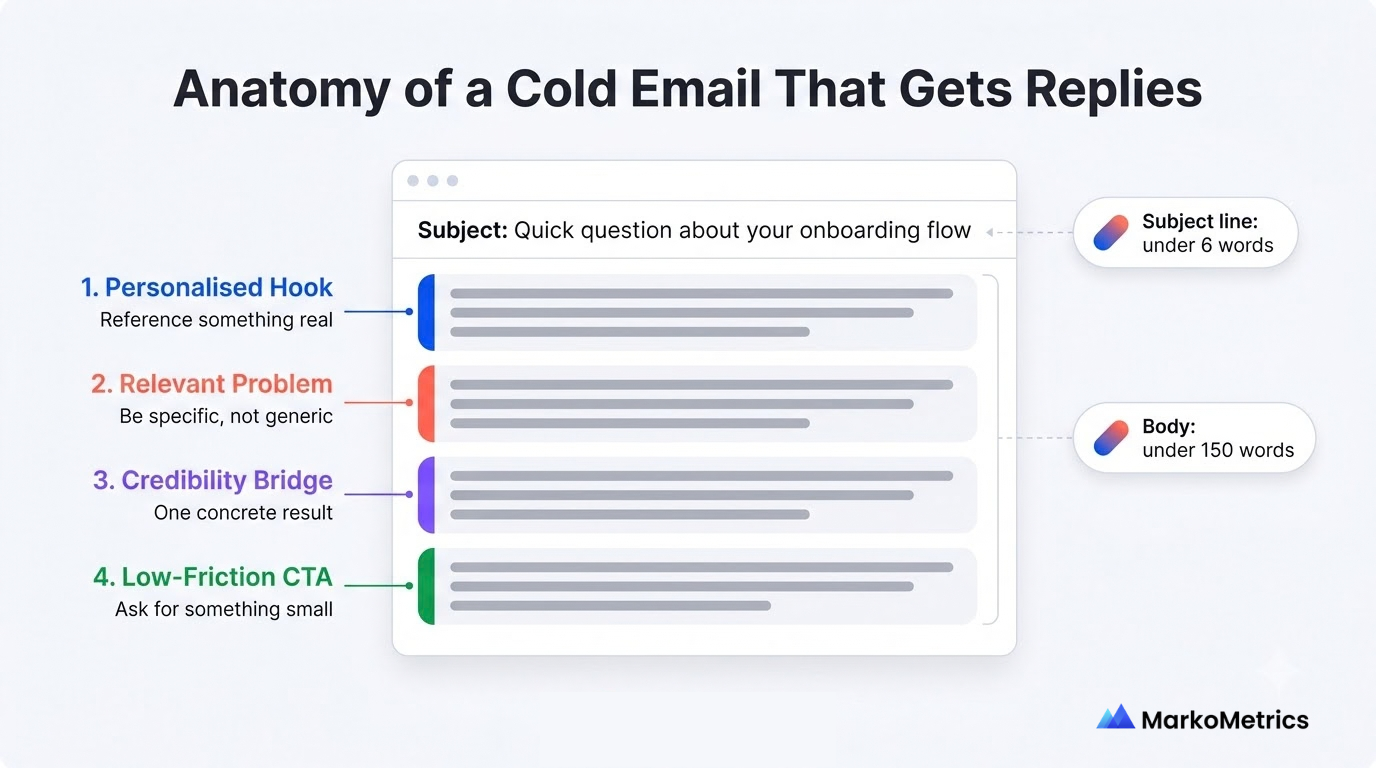
A note on subject lines: Keep them under six words. Write them the way a human would, not a marketing department. "Quick question about your onboarding flow" will outperform "Accelerate Your SaaS Growth with Our Proven Framework" every time.
On follow-up: Most replies do not come from the first email. They come from follow-ups. A five-step sequence spread across twelve to fourteen days is a solid starting framework. Each follow-up should add value or shift the angle slightly rather than just repeating the original ask.
Step 4: Choose the Right Outbound Channels
Not every channel works equally well for every SaaS audience. Here is a practical breakdown of the main outbound channels and when to use each one.
Cold Email
This is still the highest-return outbound channel for B2B SaaS. It scales well, is easy to personalise at volume with the right tools, and produces measurable results quickly. It works best when sent from a warmed-up secondary domain with proper technical setup in place.
LinkedIn Outreach
LinkedIn is particularly effective for reaching senior decision-makers at VP level and above who are actively engaged on the platform. A well-crafted connection request followed by a short, non-salesy opening message consistently outperforms a direct pitch sent in a message request. Keep early messages conversational, not transactional.
Cold Calling
More SaaS founders are surprised by this than they should be. Cold calling is not obsolete. It works especially well in industries where buyers are not heavy email users, and it works best as a follow-up to an email rather than a cold standalone channel. A call that references a previous email feels warmer and more intentional.
Content-Led Outreach
This approach involves sharing something genuinely useful before making any ask. A relevant industry insight, a short free audit, a data point specific to their business. This builds trust before the pitch and tends to get higher reply rates with senior buyers who are used to ignoring traditional cold outreach.
The most effective outbound systems combine two or three of these channels in a coordinated sequence. A prospect who receives a personalised email, sees you engage with their LinkedIn content, and then gets a follow-up call is far more likely to respond than one who only gets an email.
Step 5: Set Up Your Outbound Infrastructure
This is the part nobody finds exciting, but it is what makes everything else actually work.
Use a secondary sending domain. Never send cold outreach from your primary business domain. If something goes wrong with deliverability, you do not want your main domain reputation affected. Set up one or two secondary domains that are closely related to your main brand and use those for outbound.
Authenticate your emails. SPF, DKIM, and DMARC records are not optional. Without them, your emails land in spam regardless of how good your copy is. Set these up before you send a single email.
Warm up your domain. A brand new domain needs four to six weeks of gradual warm-up before you can send outbound at volume. Tools like Instantly or Smartlead have built-in warm-up features that automate this process.
Use a sequencing tool. Manual outreach does not scale. Tools like Instantly, Smartlead, or Lemlist let you set up multi-step sequences, track performance, and manage replies in one place.
Log everything in a CRM. HubSpot, Pipedrive, or even a well-structured Google Sheet works for early-stage teams. The point is to track every touchpoint so you can see exactly where prospects drop off and what is working at each stage.
Recommended sending volume for a new domain: start at twenty to thirty emails per day and increase gradually over four to six weeks as your domain builds a healthy sending reputation.
Step 6: Measure What Actually Matters
Open rates and email deliveries are not pipeline metrics. Here is what you should be tracking and what healthy benchmarks look like for a well-run outbound system:
| Metric | Healthy Benchmark |
|---|---|
| Email open rate | 40% and above |
| Reply rate | 5% to 10% |
| Positive reply rate | 2% to 4% |
| Meeting booked rate | 1% to 3% of contacts |
| Pipeline generated per month | Set by your average deal size and revenue target |
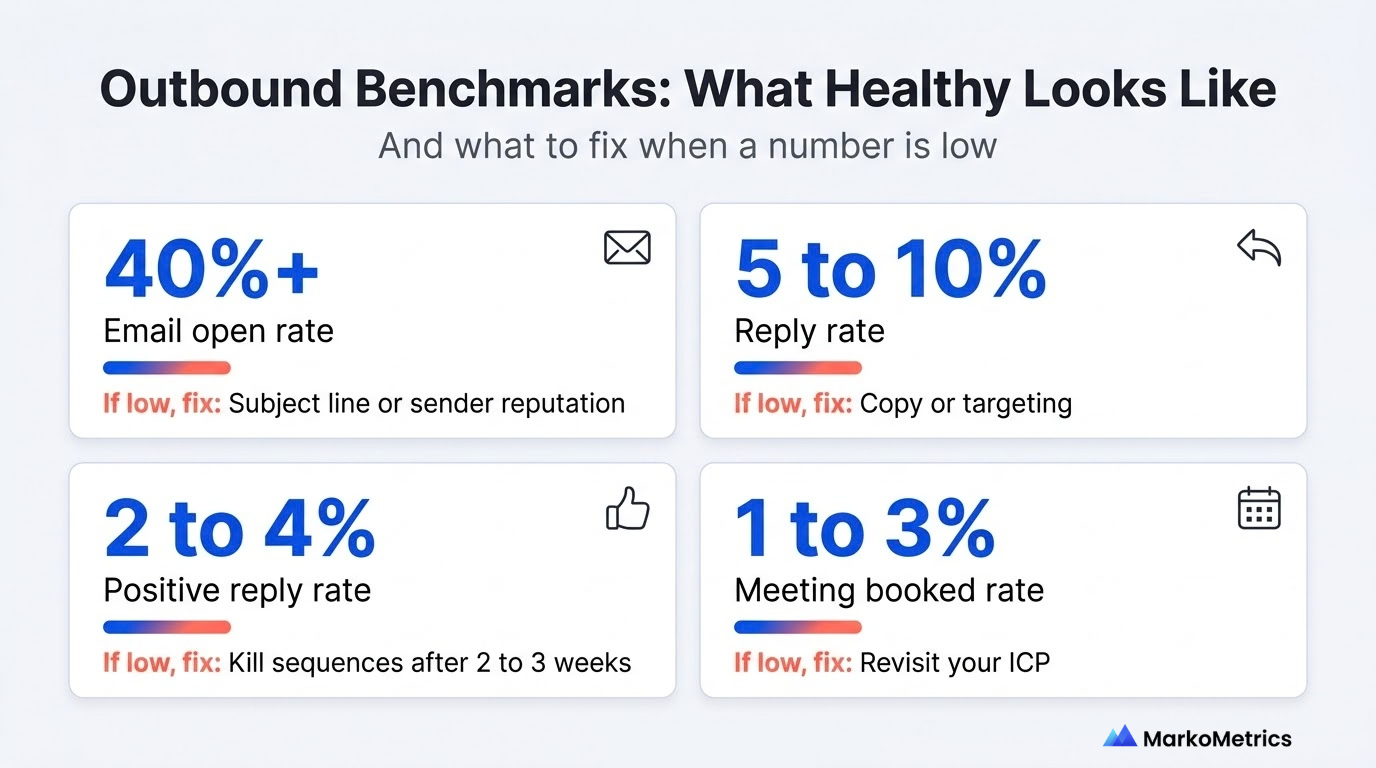
Use these benchmarks as diagnostic tools rather than targets to hit. If your open rate is below 30%, the problem is likely your subject line or your sender reputation. If your reply rate is low but open rate is healthy, the problem is your copy or your targeting. If meetings are not converting to opportunities, the problem is your ICP.
Build a weekly review into your outbound process. Look at sequence performance, identify what is underperforming, and make one focused change at a time. Running too many experiments simultaneously makes it impossible to know what is actually driving improvement.
Kill sequences that are not working within two to three weeks of clean data. Double down on segments, messages, and channels that are producing positive replies and booked meetings.
Building a Pipeline You Can Predict
Outbound lead generation for SaaS is not about volume, aggression, or clever tricks. It is about precision. The right message, to the right person, through the right channel, at the right time.
When those four elements come together inside a well-built system, outbound stops being a gamble and starts being a predictable engine for pipeline growth.
SaaS brands that build this system in 2026 will not have to depend on slow-building organic traffic, unpredictable ad performance, or waiting for referrals to trickle in. They will have a process they can run, measure, and improve every single month.
The best time to build that system is before you desperately need it. Start with a clear ICP, a focused list, one well-written sequence, and the basic infrastructure in place. Then iterate from there.
Ready to build a predictable outbound pipeline for your SaaS brand?
At MarkoMetrics, we help B2B SaaS companies design and execute outbound systems that generate qualified pipeline without the guesswork. Book a free 30-minute strategy call and we will audit your current outreach approach and show you exactly where the gaps are.
Frequently Asked Questions
How many emails should I send per day for SaaS outbound?
Start with twenty to thirty emails per day on a warmed-up secondary domain. Scale gradually over four to six weeks. Most small SaaS teams find a sweet spot between fifty and one hundred emails per day once their domain is fully warmed up and their sequences are tested.
What is a good reply rate for cold email outreach?
A reply rate of five to ten percent is considered healthy for well-targeted B2B outbound. If you are below three percent, revisit your ICP, your copy, and your subject lines before increasing volume.
Should I use email or LinkedIn for SaaS outbound?
Both work, and they work best together. Use cold email as your primary channel and LinkedIn as a supporting channel for warming up senior prospects and following up with those who have not replied to email. The combination consistently outperforms either channel alone.
How long should a cold email be?
Keep it under one hundred and fifty words. Short emails get read. Long emails get skimmed or deleted. If you cannot explain your value and make your ask in five to seven sentences, the message needs to be simplified.